Camera anxiety is more common than most people realize. The moment a lens points in your direction, something shifts — your posture stiffens, your smile becomes forced, your mind goes blank. You're suddenly hyperaware of every detail: how your hands look, whether your expression seems natural, what the camera is capturing that you can't control. For many professionals, entrepreneurs, and content creators, this anxiety is a genuine obstacle. It shows up in stiff headshots, awkward brand photos, and video calls where you feel like you're performing rather than connecting.
Here's the important truth: camera anxiety is not a personality flaw, and it's not permanent. It's a learned response — and like any learned response, it can be unlearned. This guide covers the psychology behind camera fear, practical techniques to feel relaxed and natural in front of any camera, and how to build the kind of lasting confidence that makes every photo session — from professional headshots to social media content to video calls — feel natural and even enjoyable.
Whether you're a small business owner who dreads the annual team photo, a professional who keeps putting off updating your LinkedIn headshot, or a content creator who freezes the moment you hit record, this guide is for you.
Understanding Camera Anxiety: Why It Happens
Before you can overcome camera anxiety, it helps to understand where it comes from. Camera anxiety isn't irrational — it has real psychological roots that make complete sense once you understand them.
The Evaluation Apprehension Effect
Psychologists call it "evaluation apprehension" — the heightened self-consciousness that occurs when we believe we're being observed and judged. In everyday life, we're constantly being seen by others, but we don't usually feel anxious about it because the observation is fleeting and informal. A camera changes the equation entirely. A camera creates a permanent record. It freezes a single moment and makes it available for repeated viewing, scrutiny, and judgment — by you, by others, and potentially by a large audience.
This permanence is what makes cameras feel threatening in a way that ordinary social observation doesn't. Your brain registers the camera as a high-stakes evaluation, and it responds accordingly — with the same physiological stress response it would use for any high-stakes situation: elevated heart rate, muscle tension, heightened self-monitoring, and a narrowing of attention onto perceived flaws.
The Mirror Reversal Problem
There's another layer to camera anxiety that many people don't realize: most of us are accustomed to seeing ourselves in mirrors, which show a reversed image. When we see ourselves in photos or on video, we're seeing the non-reversed version — the version everyone else sees. This unfamiliar image often feels "wrong" or less attractive than the mirror version, even though it's actually more accurate. This is called the "mere exposure effect" — we prefer what we're familiar with, and we're most familiar with our mirror image.
This means that a significant portion of camera anxiety is actually about unfamiliarity with your own appearance as others see it. The good news: this specific anxiety diminishes rapidly with exposure. The more you see yourself in photos and on video, the more familiar — and comfortable — that image becomes.
The Performance Trap
Camera anxiety is also fueled by the belief that you need to perform for the camera — that you need to produce a specific expression, adopt a specific pose, and project a specific version of yourself that's somehow better than your natural self. This performance mindset is exhausting and counterproductive. It creates exactly the stiffness and artificiality that makes photos look bad.
The most photogenic people aren't performing for the camera — they're simply being themselves in front of it. The goal isn't to produce a perfect expression; it's to feel relaxed enough that your natural expressions emerge. Understanding this distinction is the first step toward genuine camera confidence.
The Physical Techniques: Calming Your Body Before the Camera
Camera anxiety lives in the body as much as the mind. Before you can think your way to confidence, you need to address the physical tension that anxiety creates. These techniques work quickly and can be used immediately before any photo session, video call, or content shoot.
Diaphragmatic Breathing
Slow, deep breathing is the fastest way to activate your parasympathetic nervous system — the "rest and digest" system that counteracts the stress response. When you're anxious, your breathing becomes shallow and rapid, which reinforces the anxiety. Deliberately slowing and deepening your breath sends a direct signal to your nervous system that you're safe.
The technique: Inhale slowly through your nose for a count of four, letting your belly expand (not just your chest). Hold for a count of two. Exhale slowly through your mouth for a count of six. Repeat three to five times before stepping in front of the camera.
This simple technique can noticeably reduce physical tension within sixty seconds. Many professional actors, speakers, and performers use variations of this technique before every performance — not because they're nervous, but because it reliably produces a calm, grounded physical state.
Progressive Muscle Relaxation (Quick Version)
Anxiety causes muscle tension, and muscle tension reinforces anxiety. Breaking this cycle physically can interrupt the anxiety loop. A quick version of progressive muscle relaxation works well before a photo session.
The technique: Starting with your face, deliberately tense each muscle group for five seconds, then release completely. Scrunch your face tight, then let it go. Shrug your shoulders up to your ears, then drop them. Make fists, then open your hands wide. Roll your neck gently. This deliberate tension-and-release cycle helps your muscles find a genuinely relaxed state rather than the low-level tension that anxiety maintains.
The Power Pose Warm-Up
Research on body language suggests that adopting expansive, open postures — what psychologist Amy Cuddy called "power poses" — can shift your psychological state toward greater confidence. Whether or not the hormonal effects are as dramatic as originally claimed, the practical effect is real: standing tall with open posture feels different from hunching, and that physical difference influences your mental state.
The technique: Before your photo session, spend two minutes standing with your feet shoulder-width apart, shoulders back and down, chin level, and arms either at your sides or on your hips. Breathe deeply. This posture is the opposite of the collapsed, protective posture that anxiety produces — and deliberately adopting it can shift your state.
Shake It Out
One of the simplest and most effective physical techniques is also the most overlooked: literally shaking out tension. Shake your hands, roll your shoulders, shake your arms, bounce lightly on your feet. This releases physical tension quickly and has the added benefit of making you feel slightly silly — which is actually useful, because it breaks the serious, high-stakes mental frame that anxiety creates.
The Mental Techniques: Reframing Your Relationship with the Camera
Physical techniques address the symptoms of camera anxiety; mental techniques address the cause. These approaches help you fundamentally change how you think about being photographed.
Shift from Self-Focus to Other-Focus
Camera anxiety is fundamentally self-focused. You're thinking about how you look, what the camera is capturing, whether your expression is right. This intense self-monitoring is both exhausting and counterproductive — it's what creates the stiff, self-conscious look that you're trying to avoid.
The antidote is to shift your focus outward. Instead of thinking about yourself, think about the person you're communicating with — the viewer who will eventually see this photo or video. What do you want them to feel? What do you want to communicate to them? This outward focus naturally produces more genuine, engaging expressions because you're actually thinking about connection rather than performance.
For headshots and brand photos, think about your ideal client or customer. What do you want them to feel when they see your photo? Confidence? Warmth? Expertise? Approachability? Focusing on that intended feeling shifts your attention from self-monitoring to genuine communication — and the difference shows in the photos.
Reframe the Camera as a Tool, Not a Judge
The camera is a neutral object. It doesn't have opinions about you. It doesn't judge your appearance, your expression, or your worth. It simply records light. The judgment you fear isn't coming from the camera — it's coming from your own internal critic, projected onto the camera.
A useful reframe: think of the camera as a communication tool, like a phone or a microphone. You don't feel anxious speaking into a microphone (usually) because you understand it as a neutral tool for amplifying your voice. The camera is a neutral tool for amplifying your visual presence. It's on your side — it's helping you communicate with people you can't reach in person.
The "Good Enough" Permission
Perfectionism is a major driver of camera anxiety. The belief that you need to look perfect — that any flaw captured by the camera is a failure — creates enormous pressure that makes natural, relaxed photos nearly impossible.
Give yourself explicit permission to be "good enough." The goal of a headshot or brand photo isn't perfection — it's authenticity and connection. A photo where you look genuinely warm and approachable will always outperform a technically perfect photo where you look stiff and guarded. Viewers connect with realness, not perfection.
This doesn't mean settling for poor quality — it means releasing the impossible standard of flawlessness and replacing it with the achievable standard of genuine, authentic presence.
Exposure Therapy: The Most Reliable Long-Term Solution
The most reliable way to reduce camera anxiety over time is simple, repeated exposure. The more time you spend in front of cameras, the more familiar and less threatening the experience becomes. This is the same principle behind any exposure-based anxiety reduction — the feared stimulus loses its power through repeated, non-threatening contact.
Practical exposure exercises:
- Take a selfie every day for two weeks. Don't filter or edit them. Just look at them. Notice how your comfort with your own image increases over time.
- Record yourself speaking for one minute on your phone. Watch it back. Do this daily for a week. The discomfort of watching yourself on video diminishes rapidly with repetition.
- Practice in low-stakes environments before high-stakes ones. Take photos with friends before a professional shoot. Record casual video content before a formal presentation.
The goal isn't to eliminate all self-consciousness — it's to reduce it to a manageable level where it no longer interferes with your natural expression and presence.
Ready to see how great your photos can look when you're relaxed and confident? Glowup's AI photo platform transforms your photos into polished professional images. Try it free at glowuplab.app.
Practical Preparation: How to Set Yourself Up for Success
Beyond the psychological and physical techniques, practical preparation plays a major role in camera confidence. Much of what feels like camera anxiety is actually uncertainty — uncertainty about how you look, what to do with your hands, whether the lighting is right. Reducing that uncertainty through preparation reduces anxiety.
Know Your Best Angles Before the Shoot
One of the most effective ways to reduce camera anxiety is to arrive at a photo session already knowing what works for you. Spend time before any important shoot experimenting with angles, expressions, and lighting on your phone. Find the angle that feels most natural and flattering. Practice the expression you want to project — not a forced smile, but the genuine expression you have when you're engaged in a conversation you enjoy.
This preparation transforms the photo session from an uncertain, high-stakes evaluation into a familiar, low-stakes execution of something you've already practiced. You're not discovering how you look on camera — you already know.
Prepare Your Environment for Video Calls
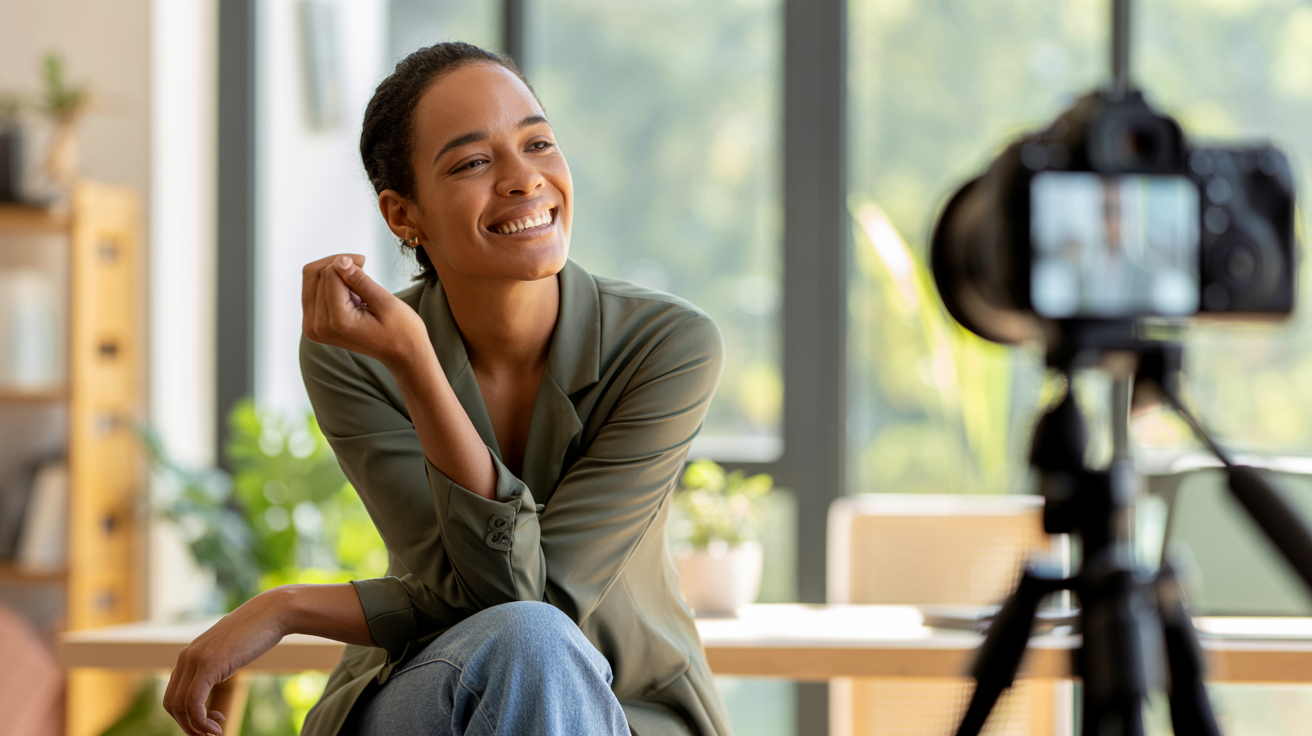
For video calls and virtual meetings, camera anxiety is often compounded by environmental uncertainty: Is the lighting good? Is the background distracting? Is the camera angle flattering? Addressing these environmental factors removes a significant source of anxiety.
Lighting: Position yourself facing a window or a ring light. Front lighting is the most flattering for video calls — it illuminates your face evenly and eliminates harsh shadows. Avoid sitting with a window behind you, which creates a silhouette effect.
Background: A clean, uncluttered background reduces visual noise and keeps the focus on you. A bookshelf, a plain wall, or a simple home office setup all work well. Avoid busy, distracting backgrounds that compete with your presence.
Camera angle: Position your camera at eye level or slightly above. Looking up at a camera is unflattering; looking down at a camera creates a more authoritative, engaged appearance. Stack books under your laptop if needed to raise the camera to the right height.
Framing: Position yourself so your eyes are in the upper third of the frame, with some space above your head. This is the most visually balanced framing for video calls and portraits.
Brief Your Photographer
If you're working with a professional photographer, tell them about your camera anxiety. A good photographer will adjust their approach — giving you more time to warm up, providing more direction and feedback, creating a more relaxed atmosphere. Many photographers are experienced at working with anxious subjects and have specific techniques for helping people relax.
Ask for a few minutes at the start of the session to warm up — to take some test shots, get comfortable with the environment, and find your rhythm before the "real" shooting begins. Most photographers are happy to accommodate this, and the warm-up shots are often some of the best of the session because they capture genuine, unguarded moments.
Use Music to Shift Your State
Music is one of the most powerful and underused tools for managing emotional state. Before a photo session, create a playlist of music that makes you feel confident, energized, and like yourself. Listen to it while you're getting ready, on the way to the shoot, and if possible, during the session itself.
The specific music matters less than the effect it has on you. Some people feel most confident with high-energy music; others prefer something calm and grounding. Experiment to find what shifts your state in the direction you want.
Building Long-Term Camera Confidence: A Progressive Practice
Camera confidence isn't built in a single session — it's built through consistent practice over time. Here's a progressive framework for building lasting confidence in front of any camera.
Week 1-2: Daily Selfie Practice
Take one selfie per day in different lighting conditions and locations. Don't filter or heavily edit them. Look at them. Notice what you like. Notice what you're learning about your own face, angles, and expressions. The goal isn't to produce perfect photos — it's to build familiarity with your own image.
Week 3-4: Video Practice
Record yourself speaking for one to two minutes per day on your phone. It can be anything — a summary of your day, your thoughts on something you read, a practice pitch for your business. Watch each recording back. Notice your natural expressions, your vocal patterns, your body language. This is uncomfortable at first and becomes progressively easier.
Month 2: Low-Stakes Photo Sessions
Arrange informal photo sessions with a friend or family member. Practice the techniques from this guide — the breathing, the outward focus, the "good enough" permission. Experiment with different expressions and poses. Use these sessions as practice runs for higher-stakes shoots.
Month 3+: Professional Sessions with Preparation
By this point, you've built a foundation of familiarity with your own image and practiced the core techniques. Approach professional photo sessions — headshots, brand photos, team photos — with the preparation framework: know your angles, brief your photographer, use music to set your state, and focus on communicating with your eventual viewer rather than performing for the camera.
When AI Photo Tools Can Help Bridge the Gap
For professionals who need high-quality photos now — before they've had time to build camera confidence through practice — AI photo platforms offer a practical solution. Tools like Glowup use artificial intelligence to enhance your existing photos, transforming everyday images into polished professional headshots and brand photos.
This is particularly valuable for:
Professionals updating their LinkedIn or website photos: You don't need to schedule a full photoshoot to get a professional headshot. AI enhancement can transform a well-lit phone photo into a polished professional image suitable for LinkedIn, your website bio, or a media kit.
Small business owners who need consistent team photos: Coordinating a team photoshoot is logistically complex and expensive. AI photo platforms can create consistent, professional team headshots from individual photos taken in different conditions — ensuring your team page looks cohesive and professional without requiring everyone to be in the same place at the same time.
Content creators building a visual library: When you're building a social media presence, you need a consistent stream of high-quality images. AI enhancement can elevate your everyday photos to a professional standard, giving you more usable content from every shoot.
Anyone who wants to see what they look like at their best: Sometimes the most powerful antidote to camera anxiety is seeing a genuinely great photo of yourself. AI enhancement can produce that image — and seeing yourself looking confident and polished can shift your self-perception in ways that make future photo sessions easier.
Ready to create professional photos that reflect your best self? Start your free trial at Glowup — the AI photo platform for professionals, entrepreneurs, content creators, and small business owners.
Camera Anxiety in Specific Contexts
Camera anxiety manifests differently in different contexts. Here's how to apply the core techniques to specific situations.
Professional Headshots
Headshots are high-stakes because they're permanent and widely seen. The preparation framework is especially important here: know your angles before the session, brief your photographer, use the breathing and physical relaxation techniques immediately before shooting, and focus on communicating warmth and competence to your eventual viewer rather than performing for the camera.
One specific technique for headshots: Think of a person you genuinely like and respect — a mentor, a close friend, a valued colleague. Imagine you're looking at them when you look at the camera. This produces a genuine warmth in your expression that no amount of "smile for the camera" instruction can replicate.
Video Calls and Virtual Meetings
Video call anxiety is increasingly common as remote work has made cameras a daily presence in professional life. The environmental preparation covered earlier (lighting, background, camera angle) addresses much of this anxiety. For the psychological component, remember that your colleagues and clients are focused on what you're saying, not on scrutinizing your appearance. The camera is a communication tool — focus on the communication, not the camera.
Social Media Content Creation
Content creation anxiety often stems from the imagined audience — the fear of judgment from people who will see your content. A useful reframe: most people who see your content are not looking for reasons to criticize you. They're looking for value, connection, and entertainment. Focus on providing those things, and the camera becomes a tool for connection rather than a source of judgment.
Start with lower-stakes content formats — static photos rather than video, behind-the-scenes content rather than polished presentations — and build up to more visible formats as your comfort increases.
Team Photos for Small Businesses
If you're coordinating a team photo session and some team members have camera anxiety, acknowledge it openly. Normalize the experience — most people feel some version of this. Build in warm-up time at the start of the session. Create a relaxed, low-pressure atmosphere with music, conversation, and humor. The more relaxed the environment, the more natural the photos.
Conclusion
Camera anxiety is one of the most common obstacles between professionals, entrepreneurs, and content creators and the high-quality photos they need to build their brand and advance their careers. But it's not a fixed trait — it's a learned response that responds to the right techniques and consistent practice.
The core framework is straightforward: understand the psychology (evaluation apprehension, the mirror reversal problem, the performance trap), address the physical tension with breathing and relaxation techniques, reframe your mental relationship with the camera, and build familiarity through progressive exposure. Prepare practically — know your angles, set up your environment, brief your photographer — and focus on communicating with your eventual viewer rather than performing for the camera.
Camera confidence isn't about becoming a different person. It's about becoming comfortable enough with the camera that your natural self — warm, capable, genuine — can come through. That's the version of you that makes great photos. And with the right techniques and consistent practice, it's entirely within reach.
For those who need professional-quality photos now, AI photo platforms like Glowup can bridge the gap — transforming your existing photos into polished professional images while you build the camera confidence that will serve you for years to come.