Your brand photos are one of the hardest-working assets in your entire business. They show up on your website hero banner, across every social media platform, on your LinkedIn profile, in email newsletters, on podcast guest pages, and in press features. Before a potential client reads a single word you've written, they've already formed an impression based on how you look in those images. And one of the most impactful decisions you'll make for any brand photoshoot is what you choose to wear.
Outfit planning for brand photos isn't about vanity — it's strategy. The right brand photo outfits reinforce your credibility, communicate your values, and create visual consistency across every touchpoint your audience encounters. The wrong outfit can undermine months of careful brand building in a single frame. This complete outfit planning guide for brand photoshoots will walk you through every decision, from color theory to fabric selection to practical day-of-shoot logistics, so you show up confident, camera-ready, and fully aligned with the brand you've built.
Whether you're a small business owner preparing for your first professional shoot, an entrepreneur refreshing your personal brand, or a content creator investing in a new visual library, this guide has you covered.
Why Your Outfit Choices Make or Break Brand Photos
Clothing communicates before you ever open your mouth. In a brand photo, your outfit is doing the heavy lifting of nonverbal communication — it tells your audience whether you're approachable or authoritative, creative or corporate, relaxed or polished. A well-chosen outfit creates instant trust. A poorly chosen one creates instant friction.
What many people don't realize is that there's a significant gap between what looks good in person and what photographs well. Certain colors vibrate on camera. Certain fabrics catch light in unflattering ways. Patterns that look subtle to the naked eye can create distracting visual artifacts in a photograph. Understanding these differences is the key to professional photo outfits that actually deliver results.
Brand photos are also a long-term investment. Unlike a social media post that lives for a day, your brand images will likely be used for six months to two years — sometimes longer. A single photoshoot can produce images for your website, social profiles, email marketing, speaking bios, media kits, and more. When you factor in how many times those images will be seen, the case for spending serious time on outfit planning becomes obvious. Every hour you invest in choosing the right brand photoshoot clothing pays dividends across hundreds or thousands of impressions.
Start With Your Brand Identity, Not Your Wardrobe
The biggest mistake people make when planning brand photo outfits is starting in their closet. Instead, start with your brand. Before you pull a single item off a hanger, ask yourself three questions: What three words describe my brand personality? What feeling do I want someone to have when they see my photos? And what does my ideal client or customer expect from someone in my industry?
Your answers to those questions should drive every outfit decision that follows.
If your brand personality is approachable, warm, and creative, you'll lean toward softer colors, relaxed silhouettes, and interesting textures. If your brand is authoritative, strategic, and premium, you'll gravitate toward structured pieces, a refined color palette, and minimal accessories. If your brand is bold, energetic, and disruptive, you might embrace saturated colors, unexpected combinations, and statement pieces.
Here are some examples to illustrate the mapping:
A tech founder building a SaaS product might choose a well-fitted blazer over a simple crew-neck tee, paired with tailored trousers — polished but not corporate, approachable but credible. A wellness coach might opt for soft, earthy tones in natural fabrics — linen, cotton, cashmere — with minimal jewelry to communicate calm and authenticity. A retail shop owner might wear something that reflects the aesthetic of their store, pulling in colors from their brand palette and accessories that feel curated. A consultant or coach working with corporate clients might lean into structured suiting in classic neutrals to signal authority and expertise.
The point is that your outfit should feel like a natural extension of your brand, not a costume. When your clothing aligns with your brand identity, the photos feel authentic — and that authenticity is what builds trust with your audience.
How Many Outfits Do You Need for a Brand Photoshoot?
A common question for anyone planning a brand photoshoot is how many outfits to bring. The rule of thumb is three to five outfits for a full brand shoot, though the exact number depends on the length of your session and how you plan to use the images.
Three outfits is a solid minimum. It gives you enough variety to differentiate your website from your social media from your LinkedIn without overwhelming your planning process. Five outfits is ideal for a longer shoot (two to three hours), especially if you want a range that spans from more formal to more casual.
When planning your outfit lineup, think about variety along two axes: formality level and color family. You want at least one outfit that feels polished and professional, one that's more relaxed and approachable, and one that falls somewhere in between. Across those three to five outfits, aim for at least two distinct color families so your image library doesn't look monotone when viewed together.
It also helps to plan your outfits against specific use cases. Think about where each image will live:
- Website hero or about page: Something that feels quintessentially "you" — your most on-brand outfit.
- Social media content: A more relaxed, approachable look that invites connection.
- LinkedIn and professional directories: A polished, confident outfit that signals competence.
- Email newsletters and blog headers: Something versatile that works across contexts.
By mapping outfits to use cases, you ensure your photoshoot produces a usable library — not just a collection of pretty pictures.
The Color Rules That Make Outfits Photograph Beautifully
Color is the single most impactful element of a brand photo outfit. It's the first thing the eye registers, it sets the emotional tone of the image, and it determines whether you pop against or blend into your background. Getting color right is essential.
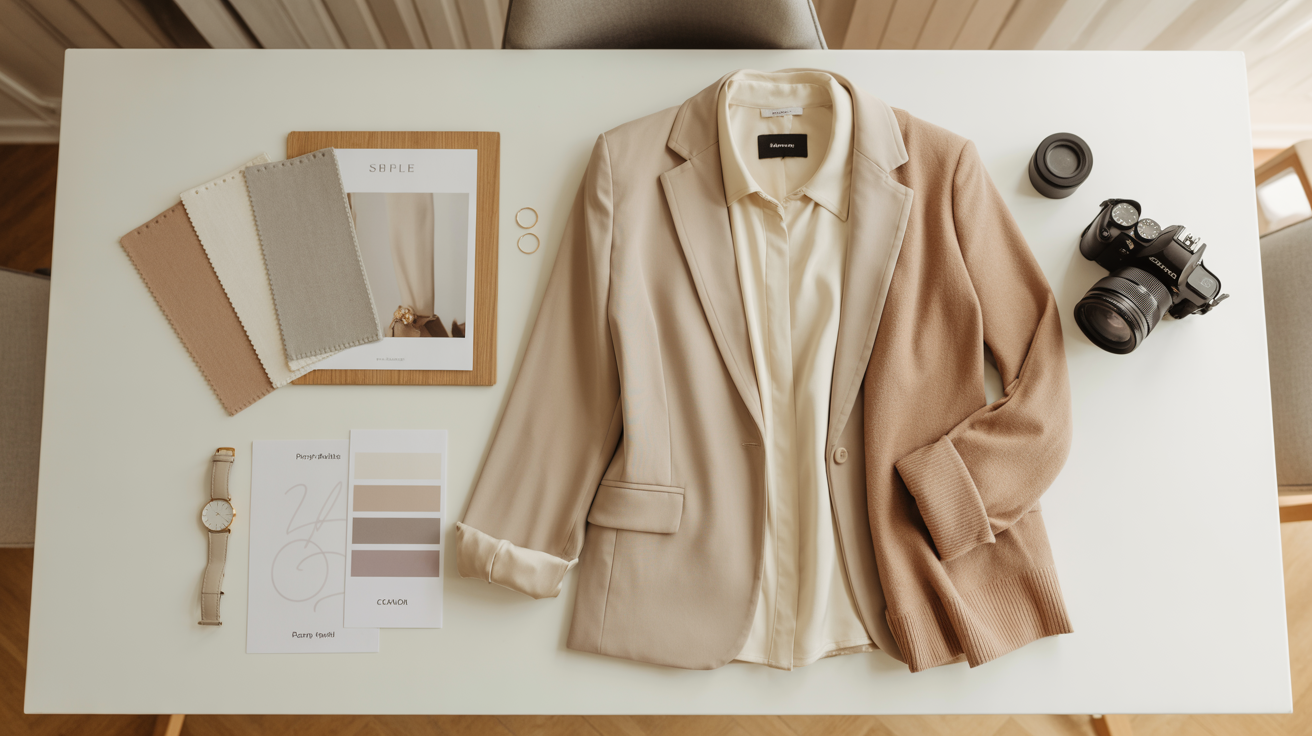
Colors that photograph well tend to be rich, saturated, and mid-toned. Deep jewel tones — emerald, sapphire, burgundy, plum — look stunning on camera across a wide range of skin tones and backgrounds. Warm earth tones like terracotta, olive, camel, and chocolate also photograph beautifully and work particularly well for brands with a warm, organic aesthetic. Classic neutrals — navy, charcoal, cream, soft white — are reliable choices that rarely disappoint.
Colors to approach with caution include pure white (which can blow out under studio lighting), pure black (which can lose detail and look flat), neon or highly saturated brights (which can cast color onto skin), and pastels on very light backgrounds (which can wash out).
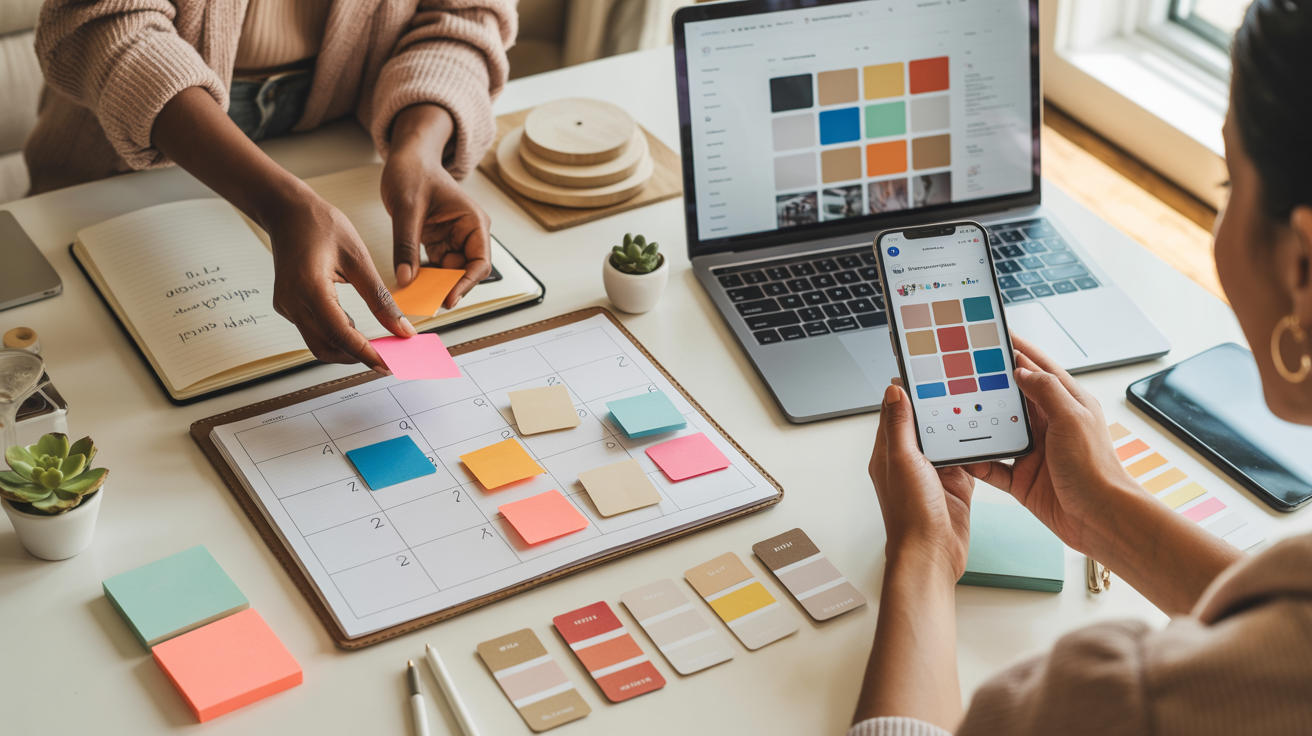
To match your outfit colors to your brand palette, pull up your brand's color guidelines and look for tones that complement — not match — your brand colors. If your brand palette is teal and gold, you don't need to wear teal and gold. Instead, choose clothing in tones that live in the same color family — a deep navy or forest green would complement teal beautifully, and a warm cream or camel would echo the warmth of gold without being literal.
Skin tone matters for flattering color choices as well. Cool undertones generally look best in blues, purples, soft pinks, and jewel tones. Warm undertones tend to shine in earth tones, warm reds, oranges, and golden hues. Neutral undertones have the widest range. If you're unsure, hold a few options up near your face in natural light and see which ones make your complexion look bright and even versus dull or uneven.
Finally, consider how your outfit colors will interact with your shoot background. If you're shooting against a white wall, a white top will disappear. If you're shooting outdoors in a lush green setting, a green outfit will blend in rather than stand out. Contrast is your friend — choose outfit colors that create visual separation from whatever's behind you.
Fabrics, Patterns, and Textures: What Works on Camera
Beyond color, the fabric of your clothing plays a major role in how your outfit photographs. Cameras capture light differently than the human eye, which means some fabrics that look perfectly fine in real life can create problems on screen.
Fabrics that look great on camera include structured cotton, linen (slightly wrinkled is fine — it reads as texture, not sloppiness), wool crepe, matte jersey, silk charmeuse, cashmere, and suede. These materials hold their shape, drape well, and have enough surface texture to create visual interest without distracting from your face.
Fabrics to avoid include anything overly shiny or reflective (satin, patent leather, metallic fabrics), which can create hot spots and distracting reflections. Very thin or sheer fabrics can read as unintentional on camera even if they look fine in person. Extremely stretchy or clingy fabrics can highlight areas you might prefer to minimize. And stiff, overly structured fabrics can look rigid and uncomfortable rather than polished.
Pattern rules are equally important. Small, tight patterns — especially thin stripes and tiny checks — can create a moiré effect on camera, producing a shimmering, wavy visual artifact that ruins the image. Larger, bolder patterns tend to photograph much better, but they also draw significant attention, so they should be used intentionally. If you wear a bold patterned piece, make sure it aligns with your brand energy.
As a general rule, solid colors are the safest choice for brand photos, especially if you're shooting multiple outfits. They keep the focus on your face and expression, they're easier to mix with different backgrounds, and they have a longer shelf life — a solid outfit doesn't look dated the way a trendy pattern might.
Texture, on the other hand, adds dimension and visual richness without the risks of pattern. A chunky knit, a textured blazer, a ribbed turtleneck, or a linen shirt all add depth to a photo that a plain smooth fabric wouldn't. Layering different textures within a single outfit is a subtle but effective way to create visual interest that photographs beautifully.
Building Your Outfit Lineup: A Practical Framework
If you're feeling overwhelmed by all these considerations, here's a simple framework for building your outfit lineup: the anchor piece approach.
For each outfit, start with one anchor piece — the item that sets the tone. This might be a tailored blazer, a structured dress, a statement coat, or a bold sweater. Choose your anchor piece first, then build the rest of the outfit around it with complementary layers, bottoms, and accessories.
Layering is your secret weapon for a brand photoshoot. A single outfit can produce multiple looks with the addition or removal of a layer. Start with a base (a fitted top or blouse), add a mid-layer (a blazer, cardigan, or vest), and optionally add an outer layer (a coat, jacket, or scarf). During the shoot, you can remove layers for different frames, effectively doubling or tripling the variety from a single outfit without extra planning.
Accessories can add polish and personality, but they need to be chosen carefully. Jewelry should be intentional — a signature watch, a pair of simple earrings, a pendant necklace. Avoid anything that jingles, catches too much light, or draws the eye away from your face. Glasses, if you wear them, are absolutely fine — just make sure they don't create glare. Scarves and hats can work beautifully for creative brands but should be skipped for corporate headshots.
Don't forget about shoes and lower-body choices, especially if your shoot includes full-body or three-quarter shots. Shoes should be clean, in good condition, and appropriate for the setting. If you're shooting outdoors on uneven ground, choose something you can actually walk in comfortably. Trousers and skirts should be hemmed properly — too long or too short reads as careless on camera.
Ready to see how your brand photos can look? Glowup's AI photo platform transforms your photos into polished professional images. Try it free at glowuplab.app.
Outfit Planning for Different Types of Brand Shoots
Different types of brand shoots call for different outfit strategies. Here's how to adjust your approach depending on the context.
Corporate and professional headshots demand a polished, clean look. Stick to structured pieces — blazers, tailored shirts, simple dresses — in solid, neutral colors. Keep accessories minimal and avoid anything that could date the image quickly. The goal is timelessness and professionalism.
Creative entrepreneur and personal brand shoots give you the most freedom. This is where you can express your personality through color, texture, and styling choices. If your brand is vibrant, wear something vibrant. If your brand is minimalist, lean into that. The key is consistency between your outfit and your brand's visual language.
Small business owner shoots (retail, food, service businesses) benefit from outfits that reflect the business's aesthetic. If you own a boutique, wear something you'd sell. If you run a bakery, an apron over a well-chosen outfit can be both authentic and visually interesting. Think about what would help a customer immediately understand what you do.
Remote and virtual professionals who need photos primarily for video calls and online presence should focus on what looks good from the chest up. Structured tops, interesting necklines, and colors that pop on a Zoom background are more important than shoes or trousers. Avoid busy patterns and choose solid colors that contrast with your typical virtual background.
Practical Prep: What to Do Before the Shoot
Even the best outfit choices can be undermined by poor preparation. Here's your pre-shoot checklist.
Steam or iron everything. Wrinkles that are barely visible to the naked eye become glaringly obvious on camera. Every piece you plan to wear should be freshly steamed or pressed. If you're traveling to your shoot location, bring a handheld steamer — it's the single most useful tool for day-of outfit prep.
Do a fit check. Fit matters more than brand, price, or trend. An inexpensive top that fits you perfectly will photograph better than a designer piece that's slightly too big in the shoulders or too tight across the chest. Try on every outfit at least a week before the shoot. Sit down, raise your arms, cross your legs — move in the clothes to make sure they look good in motion, not just standing perfectly still.
Bring backup options. Pack at least one extra top and one extra layer beyond your planned outfits. If something doesn't look right on camera, you'll be glad to have an alternative ready. It's also smart to bring options in case of unexpected weather (outdoor shoots) or a background color that clashes with your planned outfit.
Day-of logistics. Pack your outfits in a garment bag, not a suitcase or duffel. Bring safety pins, fashion tape, a lint roller, a sewing kit, and deodorant (camera lights generate heat). Wear a button-down or zip-up top on the way to the shoot so you don't mess up your hair pulling something over your head. Arrive early enough to change calmly and steam out any travel wrinkles.
Common Brand Photo Outfit Mistakes to Avoid
Even with careful planning, there are a few common pitfalls that can sabotage your brand photos.
Wearing something brand new. A brand photoshoot is not the time to debut an outfit you've never worn before. New clothes haven't been broken in — they might fit differently than expected, feel stiff, or cause you to fidget. Comfort directly impacts your expressions and body language, so wear pieces you've already tested and feel confident in.
Matching too perfectly with a co-presenter or team. If you're shooting with a business partner or team, coordinating outfits is smart — but matching identically is not. Aim for complementary colors and similar levels of formality rather than identical outfits. Variety within a cohesive palette looks intentional and professional.
Ignoring the background color. This is one of the most common mistakes. If you don't know your shoot location or background color in advance, ask your photographer. Then choose outfits that contrast with that background. Wearing navy against a dark charcoal wall, for example, will make you virtually disappear in the frame.
Over-accessorizing or under-accessorizing. Both extremes are distracting. Too many accessories compete with your face for the viewer's attention. Too few can make an outfit look incomplete or unfinished. The sweet spot is one to three intentional pieces that add polish without drawing focus from where it belongs — on you.
When AI Photo Tools Can Help
Even with meticulous planning, not every brand photo comes out perfect. Lighting might be slightly off, a background might be busier than expected, or you might love your expression in one frame but prefer the outfit styling of another. This is where AI-powered photo platforms can be a game-changer for entrepreneurs and small business owners.
AI platforms like Glowup can enhance and transform your brand photos in ways that used to require expensive retouching or reshoots. From refining lighting and color balance to creating polished professional images from everyday photos, AI brand photos are becoming a legitimate tool in the modern entrepreneur's toolkit.
AI tools are also invaluable for maintaining consistency across a series of brand photos. If you've shot with different photographers over time, or in different lighting conditions, AI can help unify the look and feel of your image library so your brand feels cohesive everywhere it appears.
For professionals who need high-quality brand imagery on an ongoing basis — for social media, blog content, newsletters, or even personal uses like updated headshots — AI photo platforms offer a practical, affordable supplement to traditional photoshoots.
Ready to create stunning brand photos? Start your free trial at Glowup — the AI photo platform for professionals, entrepreneurs, and small business owners.
Conclusion
Planning your brand photo outfits is one of the highest-impact, lowest-cost things you can do to elevate your professional image. By starting with your brand identity, choosing colors and fabrics that photograph well, building a versatile outfit lineup, and preparing carefully before the shoot, you set yourself up for images that work hard for your business for months or even years to come.
Remember the fundamentals: three to five outfits planned against specific use cases, rich mid-tone colors that complement your brand palette, structured matte fabrics with intentional texture, and a fit check well before shoot day. Avoid the common pitfalls — brand-new clothing, background color clashes, and accessory extremes — and you'll walk into your next brand photoshoot with the confidence that comes from knowing you've planned every detail.
Your brand photos are a business investment. Your outfit choices are where that investment begins. Take the time to plan them well, and the results will speak for themselves — across every platform, every email, and every first impression your brand makes.