You know the feeling. The camera comes out, and suddenly you have no idea what to do with your body. Your arms feel like awkward appendages. Your smile feels forced. You stand there, frozen, wondering where to look, how to stand, what to do with your hands. The resulting photo confirms your worst fears—you look stiff, uncomfortable, and nothing like the confident person you are in real life.
This universal struggle affects everyone from corporate executives updating LinkedIn headshots to content creators building their social media presence, from small business owners photographing themselves with products to professionals who simply want better photos for their personal brand. The camera has a way of making even the most confident people feel self-conscious and awkward.
But here's the truth: the difference between amateur-looking photos and professional-quality images often has nothing to do with expensive cameras or perfect lighting. It comes down to posing. Professional models, influencers, and people who consistently look great in photos aren't naturally more photogenic—they've simply learned the techniques that create natural, confident-looking poses.
Posing is a learnable skill, not an innate talent. With the right knowledge and practice, anyone can transform from camera-shy and awkward to confident and photogenic. This comprehensive guide will teach you everything you need to know about posing for photos, regardless of your context, body type, or experience level.
You'll learn the fundamentals of body positioning, facial expressions, and hand placement. You'll discover specific poses for standing and sitting portraits, professional headshots, social media content, and lifestyle photography. You'll understand how to adapt poses for different contexts—from formal business photos to casual personal branding content. Most importantly, you'll learn how to look natural and confident rather than stiff and posed.
Whether you're preparing for a professional photoshoot, creating content for your business, building your social media presence, or simply want to look better in everyday photos, mastering these posing techniques will transform your results. Let's dive into the art and science of posing for photos.
Why Most People Look Awkward in Photos (And How to Fix It)
The camera-induced awkwardness that most people experience isn't in your head—it's a real psychological and physical phenomenon with identifiable causes. Understanding why you feel and look awkward in photos is the first step to overcoming it.
The mirror effect creates one of the biggest challenges. You're accustomed to seeing yourself in mirrors, where your image is reversed. When you see photos of yourself—your true image as others see you—your brain registers subtle asymmetries and differences that feel "wrong" even though they're actually correct. This disconnect creates discomfort and self-consciousness that manifests as tension in your body and face.
Self-consciousness amplifies when a camera is pointed at you. Suddenly you're hyper-aware of every aspect of your appearance and positioning. This heightened awareness creates tension throughout your body—in your shoulders, jaw, hands, and facial muscles. That tension is visible in photos, creating the stiff, uncomfortable look you're trying to avoid. The irony is that trying too hard to look good makes you look worse.
Not knowing what to do with your body is perhaps the most common cause of awkward photos. When you don't have a plan or practiced poses, you default to whatever feels natural in the moment—which is usually standing straight-on to the camera with arms hanging at your sides. This positioning is universally unflattering, creating a flat, dimensionless image that doesn't showcase your best features.
The camera captures a single frozen moment, unlike real life where you're constantly in motion. In conversation, your expressions, gestures, and body language flow naturally. But when asked to hold still for a photo, that natural flow stops, and you're left trying to manufacture a "natural" look—which paradoxically creates an unnatural result.
Professional models and people who consistently look great in photos have simply overcome these challenges through practice and technique. They've learned to relax on command, developed a repertoire of go-to poses that work for their body and face, and practiced enough that posing feels natural rather than forced. They understand that looking natural in photos actually requires intentional positioning and practice—it's not truly spontaneous.
The fix for photo awkwardness is threefold: knowledge, practice, and relaxation. Knowledge means learning the specific techniques and poses that create flattering, natural-looking images. Practice means rehearsing these poses until they feel comfortable and automatic. Relaxation means developing strategies to release tension and project genuine confidence rather than forced stiffness.
The good news is that you don't need years of modeling experience to look great in photos. With the right techniques and a bit of practice, you can dramatically improve your photos immediately. The poses and strategies in this guide are designed to be accessible to everyone, regardless of experience level or natural comfort with cameras.
The Fundamentals of Good Posing
Before diving into specific poses, you need to understand the fundamental principles that make any pose work. These basics apply across all contexts, body types, and photo scenarios.
Body Positioning Basics
The foundation of good posing is body positioning. Small adjustments to how you position your body relative to the camera create dramatic differences in how you look in photos.
Never face the camera straight-on. This is the single most important rule of posing. When you face the camera directly with your shoulders parallel to the lens, you create a flat, two-dimensional image that makes you appear wider and less dynamic. Instead, angle your body 30-45 degrees away from the camera. This three-quarter angle creates depth, dimension, and a more flattering silhouette. It works for everyone, regardless of body type, and instantly makes photos look more professional.
Weight distribution matters. When standing, never distribute your weight evenly on both feet—this creates a static, rigid stance. Instead, put most of your weight on your back foot (the foot farther from the camera). This naturally creates a slight hip tilt and more dynamic posture. Your front foot can be slightly forward, creating a subtle diagonal line through your body that adds visual interest.
Create space and dimension. Avoid pressing your arms flat against your body, which makes you appear wider. Instead, create small gaps between your arms and torso—place a hand on your hip, let your arms hang slightly away from your body, or position your arms in front of you. These small spaces create definition and dimension, making you appear more three-dimensional in the two-dimensional photo.
Posture conveys confidence. Stand or sit tall with your shoulders back and down (not hunched or raised). Imagine a string pulling the crown of your head toward the ceiling, lengthening your spine. Good posture not only makes you look more confident and professional, but it also creates a more flattering silhouette and helps you feel more confident, which shows in your expression.
Elongate your neck. A common mistake is tucking your chin down or jutting it forward, both of which create unflattering angles. Instead, extend your neck slightly and bring your forehead slightly forward (not your chin). This technique, often called "turtle neck" by photographers, defines your jawline and creates a more flattering face shape. It feels slightly awkward at first but looks natural in photos.
The Role of Facial Expressions
Your facial expression can make or break a photo, regardless of how well you've positioned your body. Natural, genuine expressions are the goal, but achieving them on command requires technique.
The genuine smile starts with your eyes. A forced smile engages only your mouth, creating the dreaded "fake smile" look. A genuine smile—what Tyra Banks famously called "smizing" (smiling with your eyes)—engages the muscles around your eyes, creating slight crow's feet and a sparkle that reads as authentic. To achieve this, think of something that genuinely makes you happy or amuses you right before the photo. The resulting expression will be naturally warm and genuine.
Relax your jaw and face. Tension in your facial muscles creates a tight, uncomfortable expression. Before photos, consciously relax your jaw (let your teeth separate slightly), relax your forehead, and soften your gaze. Take a deep breath and release tension. This relaxation creates a more natural, approachable expression.
Not every photo needs a smile. For professional contexts, a slight smile or neutral expression often conveys competence and seriousness better than a full smile. A "soft face" with relaxed features and a hint of warmth in the eyes works beautifully for business headshots and professional branding.
Eye contact creates connection. Looking directly at the camera creates engagement and connection with viewers—ideal for headshots, professional photos, and content where you want to establish rapport. Looking slightly away from the camera creates a more candid, thoughtful feel—great for lifestyle content and artistic portraits. Vary your eye direction for different effects.
Think pleasant thoughts. Your internal state shows in your expression. If you're thinking "I hate having my photo taken" or "I look terrible," that negativity will show in your face. Instead, think genuinely positive thoughts—recall a happy memory, think about someone you love, or focus on gratitude. This internal positivity manifests as warmth and authenticity in your expression.
> Want to take your photos to the next level? Glowup's AI platform can enhance your images with professional backgrounds and perfect lighting, making every pose look studio-quality. Transform your photos in minutes without expensive photoshoots.
Posing for Standing Portraits
Standing poses are the foundation of most portrait photography, from professional headshots to social media content. Mastering a few versatile standing poses gives you confidence in any photo situation.
The Classic Standing Pose
This is your go-to pose for professional contexts, headshots, and any situation where you want to look polished and confident.
Body positioning: Angle your body 30-45 degrees away from the camera. If the camera is directly in front of you, turn your body so your shoulder is pointing toward the camera rather than your chest. Put your weight on your back foot (the foot farther from the camera). Your front foot can be slightly forward, creating a subtle diagonal line.
Shoulder positioning: Keep your shoulders back and down, but turn the shoulder closer to the camera slightly forward. This creates a flattering angle that shows dimension without appearing too side-on.
Hand placement options: This is where many people struggle. Try these natural-looking options:
- One hand in pocket (thumb out), other arm relaxed at side
- One hand gently touching your opposite arm
- Both hands clasped loosely in front of you at waist level
- Arms crossed loosely (not tightly—leave space between arms and body)
- One hand holding a prop (phone, coffee, notebook)
Head and face: Turn your face toward the camera even though your body is angled. Extend your neck slightly and bring your forehead slightly forward. Relax your jaw and create a genuine expression.
This classic pose works for everyone and translates well across contexts—professional headshots, LinkedIn photos, business portraits, and polished social media content.
The Power Pose
When you need to convey confidence, authority, and competence—think executive headshots, professional branding, or leadership content—the power pose delivers.
Stance: Stand with feet shoulder-width apart, weight evenly distributed or slightly forward. Face the camera more directly than in the classic pose (only 15-30 degrees angled). Stand tall with excellent posture.
Arms and hands: The key to power poses is purposeful arm positioning:
- Hands on hips (elbows out, creating strong lines)
- Arms crossed confidently (not defensively—keep it loose)
- One hand in pocket, other at side with confidence
- Hands clasped in front at waist level with strong posture
Expression: A slight smile or neutral expression with confident eye contact. You're conveying competence and authority, not warmth and approachability (though you can balance both with a subtle smile).
When to use: Professional contexts where you want to establish authority—executive headshots, speaker photos, leadership content, professional branding for consultants or coaches. Less appropriate for casual social media or approachable personal branding.
The Casual Lean
For lifestyle content, approachable personal branding, and social media, the casual lean creates a relaxed, authentic vibe.
Using walls or doorways: Stand next to a wall, doorway, or sturdy furniture. Lean your shoulder or back against it, creating a relaxed, casual posture. Cross your ankles or position one foot flat against the wall behind you. Let your arms hang naturally or place one hand in a pocket.
Creating relaxed energy: The key is looking comfortable and natural, not stiff. Shift your weight onto the surface you're leaning against. Relax your shoulders. Let your expression be soft and genuine—a slight smile or thoughtful look.
Variations:
- Lean with arms crossed loosely
- Lean with one hand in pocket
- Lean while holding a coffee or phone
- Lean with one foot propped against the wall
When to use: Social media content, lifestyle photography, approachable personal branding, casual professional content, behind-the-scenes photos.
Common Standing Pose Mistakes
Standing too straight and rigid: This creates a stiff, uncomfortable look. Always angle your body, shift your weight, and create some asymmetry.
Awkward arm positioning: Arms hanging straight down at your sides looks unnatural. Arms pressed tightly against your body makes you appear wider. Always create some space and purpose with your arms.
Flat-footed stance: Standing with feet together and flat creates a static, boring pose. Shift your weight, angle your body, and create dynamic positioning.
Facing the camera straight-on: This flattens your appearance and lacks dimension. Always angle your body at least slightly.
Forced or tense expression: Tension shows immediately in photos. Consciously relax your face, jaw, and shoulders before the photo.
Posing While Sitting
Sitting poses are essential for professional contexts (desk photos, office settings), lifestyle content, and creating variety in your photo library. Sitting well is actually more challenging than standing because there are more variables to manage.
Professional Sitting Poses
For office settings, desk photos, and professional contexts, sitting poses should convey competence while remaining approachable.
Chair positioning: Sit slightly forward in the chair rather than all the way back. This creates better posture and more engagement. Angle the chair 30-45 degrees from the camera rather than facing it straight-on.
Leg and foot placement:
- Cross your legs at the knee or ankle (whichever is more comfortable and appropriate for your outfit)
- Keep both feet flat on the floor with knees together or slightly apart
- Angle your legs to the side rather than straight toward the camera
- Avoid spreading your legs wide, which looks unprofessional
Upper body angles: Even while sitting, angle your torso slightly away from the camera. Lean slightly forward to show engagement and energy. Keep your shoulders back and posture strong.
Hand and arm options:
- Hands folded on desk or lap
- One hand on desk, other in lap
- Hands holding a pen, phone, or other work-related prop
- One arm resting on desk, other in lap
- Hands gesturing naturally (for more dynamic shots)
Working poses: For photos that show you "in action" at your desk:
- Typing on laptop (actually type, don't just rest hands on keyboard)
- Writing notes
- Looking at documents or screen
- On a phone call (if appropriate)
These poses work for LinkedIn photos, professional website headshots, office environment portraits, and business-focused content.
Casual Sitting Poses
For lifestyle content, social media, and approachable personal branding, casual sitting poses create a relaxed, authentic feel.
Relaxed positions:
- Sitting on the floor with legs crossed or tucked to the side
- Perched on the edge of a desk, table, or counter
- Lounging in a comfortable chair or couch
- Sitting on steps or outdoor seating
Using props naturally: Props make sitting poses feel more natural and give your hands purpose:
- Holding a coffee mug
- Reading a book or looking at a tablet
- Petting a dog or cat
- Holding a phone (but not looking at it—look at camera or away thoughtfully)
Creating candid looks: The goal is looking naturally caught in a moment rather than obviously posed:
- Look away from the camera as if lost in thought
- Laugh genuinely (have someone tell you a joke)
- Engage with your environment (looking out a window, at a view, etc.)
- Mid-action shots (reaching for coffee, turning a page, etc.)
Sitting Pose Mistakes to Avoid
Slouching: Poor posture looks unprofessional and unflattering. Even in casual poses, maintain some postural integrity.
Awkward leg positions: Legs spread wide, awkwardly crossed, or positioned in ways that create unflattering angles. Be mindful of how your legs are positioned and how they'll appear in the frame.
Looking too stiff or formal: In casual contexts, overly rigid sitting poses look out of place. Relax and let your body settle naturally into the position.
Sitting too far back in chairs: This often creates slouching and disengagement. Sit forward for better posture and energy.
Hand and Arm Placement: The Ultimate Guide
Hands are universally acknowledged as the most challenging aspect of posing. Even experienced models sometimes struggle with natural-looking hand placement. The reason is simple: in real life, your hands are constantly in motion, gesturing and interacting with your environment. When asked to hold still for a photo, hands suddenly feel like awkward, purposeless appendages.
Why hands are so difficult: Your hands are expressive and mobile. When you freeze them for a photo, they can look stiff, awkward, or "dead" (limp and lifeless). Additionally, hands are closer to the camera in many poses, making them appear larger and more prominent. Poor hand positioning draws attention in all the wrong ways.
The golden rule: Give your hands purpose. Hands look most natural when they're doing something or resting somewhere intentionally. Hands hanging limply at your sides or awkwardly hovering in space look unnatural.
Natural hand positions that work:
In pockets: One of the easiest solutions. Place one or both hands partially in pockets (front or back). Keep your thumb out for a more casual look, or tuck the whole hand in for a cleaner line. Don't jam your hands deep into pockets—just rest them naturally. This works for standing poses and creates clean lines.
Touching your face or hair: Light, natural touches work well:
- Gently touching your chin or jaw (thinking pose)
- Lightly touching your hair (not aggressively fixing it)
- Resting your hand on your cheek
Keep these touches light and natural—heavy-handed face touching looks forced.
Holding props: Props give hands natural purpose:
- Coffee mug or water bottle
- Phone (but don't look at it unless that's the point)
- Book, notebook, or tablet
- Bag or briefcase
- Jacket slung over shoulder
- Work-related items (tools, equipment, products)
Resting on surfaces:
- On a desk or table
- On the back of a chair
- On a railing or ledge
- On your lap when sitting
- On your hip (hand on hip pose)
Interacting with your body:
- Adjusting a watch or bracelet
- Touching your opposite arm gently
- Adjusting a collar or necklace
- Clasped together in front of you
Crossed arms: This can work but requires care. Cross your arms loosely, not tightly. Leave space between your arms and body. Keep your shoulders relaxed, not hunched. This pose can read as defensive or closed-off, so use it when you want to convey confidence and authority, not approachability.
What to avoid:
"Dead hands": Limp, lifeless hands hanging at your sides or dangling awkwardly. Hands should have some life and purpose.
Fists: Clenched fists look aggressive or tense. Keep hands relaxed and natural.
Awkward gestures: Pointing, peace signs, or other gestures that don't fit the context look forced and dated.
Hands flat against your body: This makes you appear wider. Create space between hands and torso.
Overly stiff or posed hand positions: Hands positioned in obviously artificial ways draw attention to the posing rather than looking natural.
Gender-neutral hand placement: All the techniques above work for everyone, regardless of gender. The key is natural positioning that fits your personal style and the context of the photo. Avoid gendered stereotypes (like overly delicate hand positioning or overly aggressive stances) and focus on what feels authentic to you.
Practice makes natural: The best way to develop natural-looking hand placement is practice. Take test shots trying different hand positions. Notice which feel comfortable and look natural. Build a repertoire of go-to hand positions that work for you, so you're never left wondering what to do with your hands.
Facial Expressions and Eye Contact
Your facial expression communicates more than any other element of a photo. You can have perfect body positioning and hand placement, but if your expression is forced, tense, or disconnected, the photo won't work.
The "smize" (smiling with your eyes): Tyra Banks popularized this term, but the concept is universal. A genuine smile engages not just your mouth but your entire face, especially your eyes. The muscles around your eyes crinkle slightly, your eyes narrow just a bit, and there's a genuine warmth and sparkle. This is the difference between a real smile and a forced "say cheese" smile.
To achieve a genuine smize, think of something that makes you genuinely happy right before the photo. Recall a funny memory, think about someone you love, or focus on something you're grateful for. This internal happiness manifests as authentic warmth in your eyes and smile.
Natural vs forced expressions: Forced expressions are obvious. Your smile doesn't reach your eyes. Your face looks tense. There's a disconnect between your expression and your energy. Natural expressions, even when intentionally created for a photo, feel authentic because they're rooted in genuine emotion or relaxation.
The key to natural expressions is relaxation. Before the photo, take a deep breath. Consciously relax your jaw (let your teeth separate slightly). Relax your forehead and the muscles around your eyes. Soften your gaze. This relaxation creates a foundation for natural expression.
Looking at vs away from camera: Both have their place, creating different effects.
Looking at the camera creates direct engagement and connection with viewers. It's ideal for:
- Professional headshots and LinkedIn photos
- Content where you want to establish rapport or authority
- Photos where you're "speaking" directly to your audience
- Headshots and portraits where connection is the goal
When looking at the camera, focus on the lens itself, not the screen or the photographer. Imagine you're looking at a friend or someone you're having a conversation with. This creates genuine connection rather than a blank stare.
Looking away from the camera creates a more candid, thoughtful, or artistic feel. It's ideal for:
- Lifestyle and editorial content
- Photos where you want a more natural, caught-in-the-moment feel
- Artistic portraits
- Content where you're interacting with your environment
When looking away, look at something specific, not just vaguely into space. Look at a view, an object, or a person. This gives your gaze purpose and creates a more natural look.
Conveying different emotions and energy: Different contexts require different expressions:
Professional and competent: Slight smile or neutral expression with confident eye contact. Relaxed but not overly warm. Conveys authority and credibility.
Approachable and warm: Genuine smile with warmth in the eyes. Relaxed posture and expression. Conveys friendliness and accessibility.
Thoughtful and introspective: Neutral or slight smile, often looking away from camera. Relaxed face. Conveys depth and contemplation.
Confident and powerful: Neutral expression or slight smile with strong eye contact. Strong posture. Conveys authority and strength.
Relaxed and casual: Natural smile or laugh, relaxed face and body. Often looking away or mid-action. Conveys authenticity and ease.
Relaxation techniques for natural expressions:
Breathe: Take several deep breaths before the photo. Breathing releases tension and calms your nervous system.
Move and reset: Don't hold a pose for too long. Move, shake out tension, and reset into the pose. This prevents stiffness from building up.
Think positive thoughts: Your internal state shows in your face. Focus on positive, happy thoughts rather than self-criticism or anxiety.
Engage in conversation: If someone is photographing you, talk to them between shots. Laughter and conversation create natural expressions that can be captured.
Take lots of shots: Don't expect to nail the perfect expression on the first try. Take multiple shots, allowing your expression to vary naturally. You'll capture genuine moments among the more posed shots.
Posing for Different Photo Contexts
Different contexts require different posing approaches. A pose that works perfectly for a LinkedIn headshot might look too formal for Instagram content. Understanding context-appropriate posing ensures your photos serve their intended purpose.
Professional Headshots and LinkedIn Photos
Professional contexts require poses that convey competence, credibility, and approachability. You want to look polished and professional while remaining human and relatable.
Conveying competence and approachability: The challenge is balancing authority with warmth. Too serious, and you look unapproachable or cold. Too casual, and you lack credibility. The sweet spot is confident but warm.
Body positioning: Use the classic standing pose—body angled 30-45 degrees, weight on back foot, shoulders back. This creates a professional, polished look without being stiff.
Expression: A slight to moderate smile with warmth in your eyes. Not a huge grin (too casual) but not neutral/serious (too cold). Think "confident and friendly."
Attire and grooming: Professional contexts require appropriate attire and grooming. Dress for your industry—corporate environments require more formal attire, creative fields allow more personality. Ensure hair is neat, clothing is pressed, and overall appearance is polished.
Industry-appropriate poses: Different industries have different norms:
- Corporate/Finance/Law: More formal poses, conservative attire, neutral to slight smile
- Creative/Marketing/Design: More personality, creative attire, warmer expressions
- Healthcare/Education: Approachable and warm, professional but not overly formal
- Entrepreneurship/Coaching: Confident and approachable, balancing authority with accessibility
Formal vs casual professional looks: Even within professional contexts, there's a spectrum:
- Formal: Suit or professional attire, neutral background, classic pose, slight smile
- Business casual: Button-down or blouse, more relaxed pose, warmer smile
- Casual professional: Smart casual attire, more personality in pose and expression, lifestyle setting
Social Media Content and Personal Branding
Social media requires more dynamic, personality-driven poses that showcase who you are and create connection with your audience.
Dynamic poses for Instagram and TikTok: Static, formal poses don't perform well on social media. You need energy, personality, and visual interest:
- Action shots (walking, moving, gesturing)
- Candid-looking moments (laughing, looking away, mid-action)
- Environmental interaction (touching walls, sitting on steps, engaging with surroundings)
- Varied angles and perspectives (not just straight-on shots)
Lifestyle content posing: Lifestyle content shows you in your environment, doing activities, living your life. Poses should look natural and unforced:
- Doing activities (working, cooking, exercising, creating)
- Interacting with props naturally (coffee, books, tools of your trade)
- Engaging with your environment (looking at views, walking through spaces)
- Showing personality and authenticity
Action shots and movement: Movement creates dynamic, engaging content:
- Walking toward or away from camera
- Turning or moving mid-shot
- Laughing or reacting naturally
- Gesturing while talking or explaining
- Interacting with products or environment
The key is looking natural rather than obviously posed. Even though these shots are planned and intentional, they should feel spontaneous and authentic.
Product Photography and Small Business Content
If you're a small business owner, entrepreneur, or creator who needs to photograph yourself with products or in your business environment, posing takes on additional considerations.
Posing with products naturally: The challenge is showcasing the product while looking natural and not like a cheesy infomercial:
- Hold products at chest or waist level, not awkwardly extended toward camera
- Interact with products naturally (using them, demonstrating them, examining them)
- Look at the product occasionally, not always at the camera
- Show scale and context (products in use, in environment)
- Avoid overly staged "presenting" poses
Demonstrating use without looking staged: Show products in action:
- Actually using the product (not just holding it)
- Mid-action shots (applying, opening, demonstrating)
- Natural environment (where the product would actually be used)
- Genuine expressions (not forced enthusiasm)
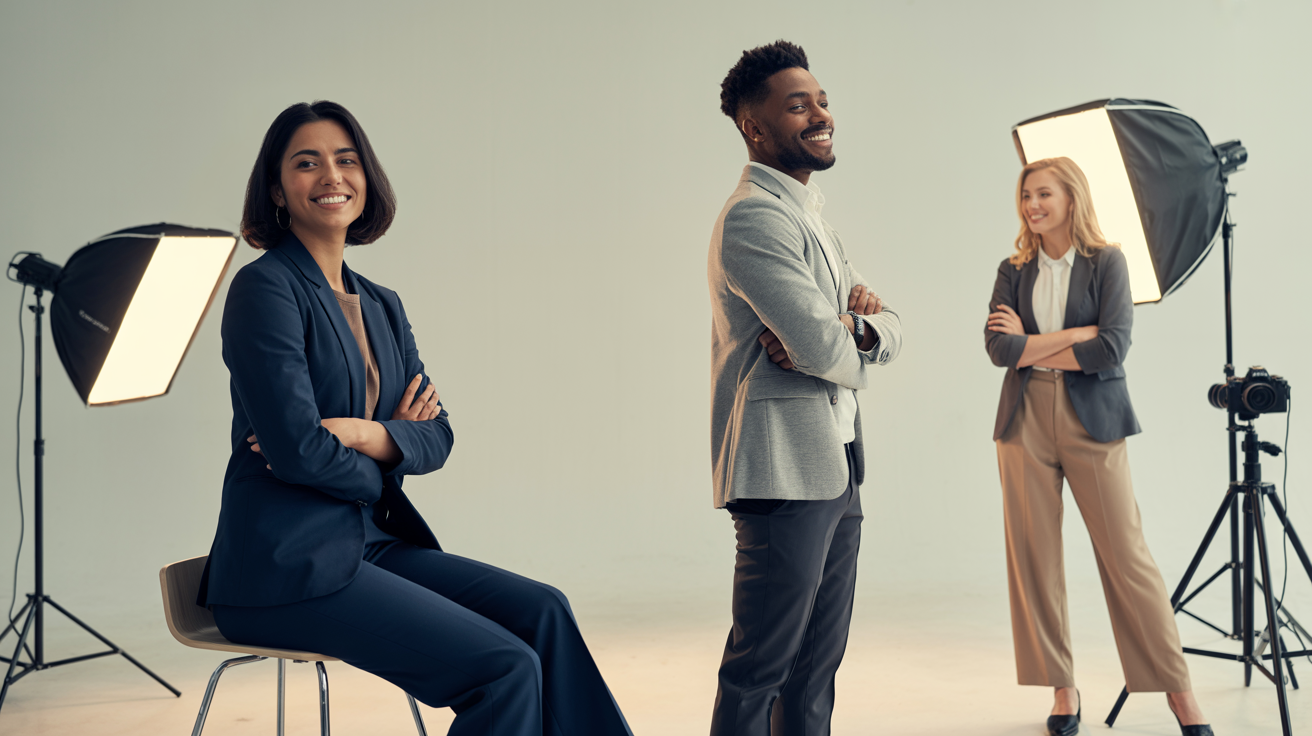
Team photos and group posing basics: If you need photos with team members or groups:
- Vary heights (some sitting, some standing)
- Create diagonal lines rather than straight rows
- Angle bodies toward center of group
- Ensure everyone is visible (no one hidden behind others)
- Natural expressions and interactions (talking, laughing, working together)
Event and Candid-Style Photos
Events, conferences, and situations where you want candid-looking photos require a different approach.
Looking natural in "candid" shots: Even planned candid shots should look spontaneous:
- Mid-conversation or mid-laugh
- Looking at something off-camera
- Interacting with environment or people
- Caught in motion or action
- Natural, unforced expressions
Movement and action poses: Don't stand still. Move, gesture, interact. The photographer can capture natural moments within that movement.
Group photo positioning: In group settings:
- Position yourself where you're visible and well-lit
- Angle your body slightly rather than facing straight-on
- Engage with the group naturally
- Be aware of your expression (avoid caught mid-blink or mid-word)
> Ready to create stunning photos with perfect poses? Sign up for Glowup and transform your images with AI-powered enhancements that make every photo look professionally shot. Perfect backgrounds, ideal lighting, and polished editing in minutes.
Advanced Posing Techniques
Once you've mastered the basics, these advanced techniques add sophistication and visual interest to your photos.
Creating depth and dimension: Photos are two-dimensional representations of three-dimensional reality. Create depth by:
- Positioning elements at different distances from camera (foreground, subject, background)
- Using angles and diagonals rather than straight lines
- Creating layers in your composition
- Using shallow depth of field (blurred background) to separate subject from background
Using leading lines and environment: Your environment can enhance your pose:
- Position yourself along leading lines (paths, railroads, architectural elements)
- Use doorways, windows, or frames within the frame
- Interact with architectural elements (leaning on railings, standing in doorways)
- Use environmental context to tell a story
Asymmetry and visual interest: Perfectly symmetrical poses are often boring. Create visual interest through asymmetry:
- Weight on one foot, not both
- One hand in pocket, other at side
- Head tilted slightly
- Body angled rather than straight-on
- Varied arm and leg positioning
Movement and dynamic poses: Static poses have their place, but movement creates energy:
- Walking toward or away from camera
- Hair or clothing moving in wind
- Mid-gesture or mid-action
- Turning or spinning
- Jumping or dynamic movement (when appropriate)
The "in-between" moments: Often the best shots happen between posed moments:
- Transitioning between poses
- Natural laughter or reactions
- Adjusting hair or clothing
- Looking away and back at camera
- Relaxing after holding a pose
Photographers often capture these in-between moments because they're more natural and authentic than held poses.
Posing for Different Body Types
Good posing works for every body type. The principles are universal, though specific applications may vary.
Universal flattering angles: These work for everyone:
- Body angled 30-45 degrees from camera (not straight-on)
- Weight on back foot
- Creating space between arms and body
- Elongating neck and spine
- Good posture
Emphasizing your best features: Everyone has features they want to emphasize:
- If you love your smile, use expressions that showcase it
- If you have great style, use poses that show your outfit
- If you're proud of your fitness, use poses that show your physique
- If you have expressive eyes, use close-up shots and eye contact
Camera angles and their effects:
- Eye level: Most natural and neutral
- Slightly above eye level: Slightly slimming, emphasizes eyes, de-emphasizes body
- Below eye level: Emphasizes height and power, can be less flattering for face
- Side angles: Create dimension and can be more flattering than straight-on
Inclusive posing that works for everyone: The techniques in this guide are designed to be universally applicable. Focus on:
- Confidence and comfort in your pose
- Natural positioning that feels authentic to you
- Emphasizing what you want to showcase
- Working with your body, not against it
Confidence over "perfect" body positioning: The most important element of any pose is confidence. A confident person in a simple pose looks better than an insecure person in a "perfect" pose. Your comfort and confidence show in your expression, body language, and overall energy.
Focus on poses that feel good to you. If a pose feels awkward or uncomfortable, it will look that way in photos. Find variations that work for your body and comfort level.
Practice and Preparation Tips
Like any skill, posing improves with practice. These strategies help you develop natural, confident posing abilities.
Mirror practice techniques: Your mirror is a free practice tool:
- Practice poses in front of a full-length mirror
- Try different body angles and see what looks best
- Practice facial expressions and find your best smile
- Work on hand placement and natural positioning
- Notice what feels comfortable and looks good
Taking test shots and reviewing: Use your phone's self-timer or ask someone to take test shots:
- Try different poses and review immediately
- Notice what works and what doesn't
- Build a collection of poses that work for you
- Practice until poses feel natural and automatic
Building a pose repertoire: Develop 5-10 go-to poses that work for you:
- 2-3 standing poses
- 2-3 sitting poses
- Several hand placement options
- Different facial expressions
- Variations for different contexts
Having a repertoire means you're never caught off-guard when a camera appears. You have reliable poses you can default to.
Warming up before photo sessions: Before important photo sessions:
- Move your body to release tension
- Practice your poses briefly
- Do facial exercises (smile big, relax, repeat)
- Take deep breaths to calm nerves
- Remind yourself of your go-to poses
Working with photographers or self-timer: Whether working with a photographer or using self-timer:
- Communicate what you want and any concerns
- Ask for feedback and direction
- Take lots of shots—quantity increases chances of great results
- Review shots periodically and adjust
- Don't be afraid to try new things
Common Posing Mistakes and How to Fix Them
Even with knowledge and practice, certain mistakes are common. Recognizing and correcting them improves your photos immediately.
Looking too stiff and unnatural:
- Problem: Tension, overthinking, holding poses too long
- Fix: Relax, breathe, move between shots, think positive thoughts, take lots of photos to capture natural moments
Awkward hand and arm placement:
- Problem: Not knowing what to do with hands, letting them hang limply or hover awkwardly
- Fix: Give hands purpose—pockets, props, touching face/hair, resting on surfaces, interacting with body
Poor facial expressions:
- Problem: Forced smiles, tense face, disconnected eyes
- Fix: Think genuinely happy thoughts, relax jaw and face, smile with your eyes, take multiple shots to capture natural expressions
Bad angles and positioning:
- Problem: Facing camera straight-on, poor posture, unflattering camera angles
- Fix: Angle body 30-45 degrees, maintain good posture, position camera at or slightly above eye level, create dimension
Over-posing and looking fake:
- Problem: Trying too hard, overly stylized poses that don't fit context, obvious posing
- Fix: Keep it simple, focus on natural positioning, move and interact naturally, capture in-between moments
Quick fixes for each mistake:
- Stiffness: Shake it out, take a break, breathe deeply
- Awkward hands: Put them in pockets or hold a prop
- Forced expression: Think of something funny, relax your face, try a neutral expression instead
- Bad angle: Turn your body, adjust camera position, check your posture
- Over-posing: Simplify, focus on one or two adjustments, prioritize natural over perfect
Conclusion
Posing for photos is a learnable skill that transforms how you look and feel in front of the camera. The awkwardness and self-consciousness that most people experience aren't permanent conditions—they're simply the result of not knowing what to do with your body, face, and hands when a camera appears.
The techniques in this guide—from fundamental body positioning and facial expressions to context-specific poses and advanced techniques—provide a comprehensive framework for looking natural and confident in any photo situation. Whether you're updating your LinkedIn headshot, creating social media content, photographing yourself for your small business, or simply want to look better in everyday photos, these posing strategies work.
The key insights to remember:
Posing is about angles and intention. Small adjustments—angling your body 30 degrees, shifting your weight to your back foot, creating space between your arms and torso—create dramatic improvements in how you look in photos.
Natural-looking poses require practice. Professional models and people who consistently look great in photos aren't naturally more photogenic—they've simply practiced enough that posing feels automatic and comfortable.
Different contexts require different approaches. A pose that works for a corporate headshot might be too formal for Instagram content. Understanding context-appropriate posing ensures your photos serve their intended purpose.
Confidence matters more than perfection. A confident person in a simple pose looks better than an insecure person in a technically perfect pose. Your comfort and confidence show in your expression and energy.
Hands need purpose. Give your hands something to do—pockets, props, touching your face or hair, resting on surfaces—rather than letting them hang awkwardly.
Expressions should be genuine. Think happy thoughts, relax your face, and smile with your eyes. Forced expressions are obvious and unflattering.
Start with the basics: angle your body, shift your weight, create good posture, give your hands purpose, and relax your face. Practice these fundamentals until they feel natural. Then build your repertoire with specific poses for standing, sitting, and different contexts.
Take test shots and review them honestly. Notice what works for your face, body, and personal style. Build a collection of 5-10 go-to poses that you can rely on in any situation. Practice in front of a mirror until these poses feel comfortable and automatic.
Remember that even professional models and photographers continue learning and refining their posing skills. Every photo session is an opportunity to practice and improve. Be patient with yourself, focus on progress rather than perfection, and celebrate the improvements you see.
The transformation from camera-shy and awkward to confident and photogenic is achievable for everyone. With the knowledge from this guide and consistent practice, you'll develop the skills to look natural, confident, and your best self in every photo. Your photos will better represent who you are, support your professional goals, enhance your personal brand, and give you confidence in any photo situation.
Start practicing today. Take some test shots trying different poses from this guide. Notice what feels comfortable and looks good. Build your confidence one photo at a time. The camera-ready, confident version of yourself is within reach—it just takes knowledge, practice, and the willingness to step in front of the camera with intention.